When to film in Nicaragua is one of the first questions international producers ask us, usually in three words: when should we shoot? Nicaragua is a year-round filming destination, but the season you pick changes your light, your look, your logistics and sometimes your budget.
This guide breaks down when to film in Nicaragua from the perspective of a local production company that has been shooting commercials and branded content from Managua since 2005.
When to film: the short answer
Nicaragua has two main seasons, not four:
- Dry season (locally called verano): roughly mid-November / December through April. Reliable sun, dry roads and the most predictable schedules on the Pacific side.
- Rainy season (locally called invierno): roughly May through October / November. Lush green landscapes, dramatic skies and often afternoon downpours, with mornings that are frequently workable.
If your board depends on blue skies and dry beaches, the dry season is the safer bet. If it depends on saturated green — jungle, coffee farms, waterfalls — the rainy season can give you a look you simply cannot get in March.
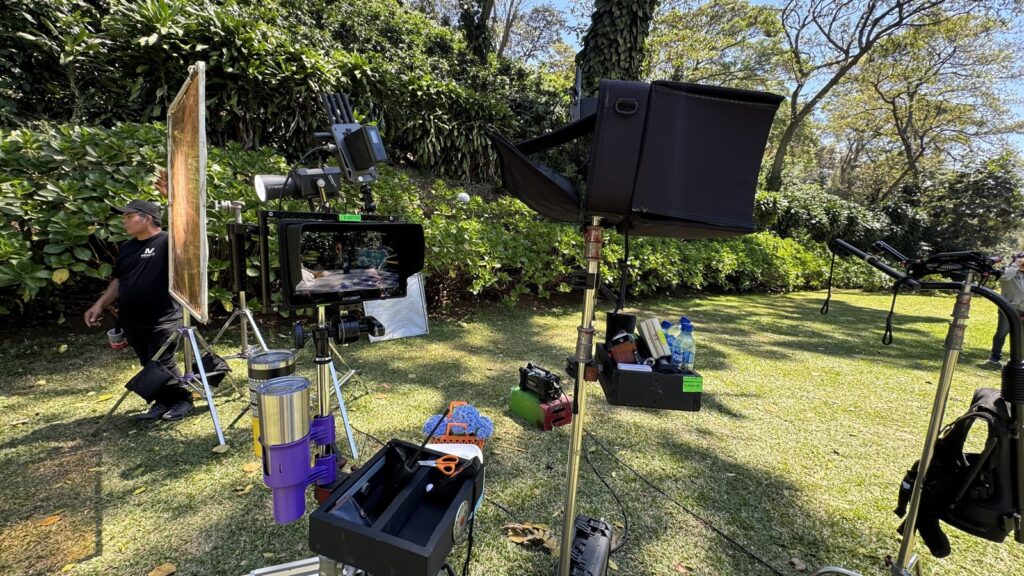
Dry season: what to expect
Pros
- Consistent sunshine on the Pacific side (Managua, Granada, León, San Juan del Sur, Rivas).
- Easier access to rural and beach locations on unpaved roads.
- Lower weather risk, which means smaller weather contingencies and fewer backup days.
- Peak tourism months — locations like Granada and San Juan del Sur look lively, which helps for lifestyle spots.
Cons and watch-outs
- Hard midday light. Nicaragua sits around 12° north, so the sun is high and harsh from late morning to mid-afternoon. Plan hero shots for early morning and golden hour, and budget for diffusion and negative fill.
- Strong winds on the Pacific coast. From roughly December to March, steady offshore winds blow across the Rivas isthmus and San Juan del Sur. Great for surf footage, harder for clean dialogue and lightweight set dressing.
- Dry, brown landscapes by March and April, especially in the Pacific lowlands.
- Haze and smoke late in the season from agricultural burning can soften distant volcano views.
- Higher demand for hotels and vehicles around Christmas, New Year and Semana Santa (Holy Week). Book early.
Rainy season: what to expect
Pros
- Vivid green everywhere — volcano slopes, coffee highlands, the Masaya and Ometepe landscapes.
- Dramatic skies and moody clouds that read as premium on camera.
- Lower demand for lodging and vehicles in many areas, which can help the budget.
- Usable mornings. In many Pacific-side locations, rain tends to arrive in the afternoon or evening, leaving productive morning windows.
- A mid-season break. Many years bring a drier stretch in July–August (locally called la canícula) that can open a window for exterior work.
Cons and watch-outs
- Afternoon storms can stop exterior work abruptly. Schedule exteriors early and keep interiors or cover sets ready.
- Muddy access roads to farms, beaches and rural locations. Plan 4×4 vehicles and extra move time.
- Higher humidity — protect lenses and electronics, and plan for condensation when moving from air-conditioned vans to set.
- Peak hurricane-season months (September–October) carry more risk, especially on the Caribbean coast and Corn Islands.
Region by region
Weather in Nicaragua changes a lot depending on where you shoot:
- Pacific lowlands (Managua, Granada, León, Masaya): the classic two-season pattern. Hot year-round; driest from December to April.
- Pacific coast (San Juan del Sur, Las Peñitas, Popoyo): sunny dry season with strong winds; rainy-season mornings are often usable for beach work.
- Northern highlands (Matagalpa, Jinotega, Selva Negra): cooler, cloudier and wetter. Mist and fog are frequent — great for atmosphere, harder for continuity.
- Ometepe and Lake Nicaragua: ferry schedules and lake conditions matter more than rain. Build buffer time into any island day.
- Caribbean coast and Corn Islands: wetter year-round with a less defined dry season. Flights and boats are weather-dependent — always plan a backup day.
Region matters as much as the calendar: when to film on the Pacific coast is not the same answer as when to film in the Caribbean.

For location ideas across all of these regions, see our guide to 10 Film Locations in Nicaragua.
Light and daylight hours
Because Nicaragua is close to the equator, daylight is fairly stable all year: roughly 11½ to 13 hours of daylight, with sunrise between about 5:20 and 6:10 am and sunset between about 5:20 and 6:15 pm depending on the month. That means:
- You do not gain long summer evenings like in the US or Europe.
- Golden hour is short — usually well under an hour. Rehearse and be ready.
- Two-location days are realistic if the move is under an hour, but tight beyond that.

How season affects your budget
Deciding when to film is not just a creative decision; it shows up in the numbers:
- Weather contingency: dry-season Pacific shoots can usually run leaner on weather days; rainy-season and Caribbean shoots should hold at least one backup day.
- Lodging and transport: holiday peaks (December–January, Holy Week) raise prices and reduce availability.
- Cover sets: in the rainy season, budget for an interior or covered location you can switch to quickly.
- Equipment: rain covers, tents, extra generators and dehumidifying cases for long rainy-season shoots.
For a full breakdown of line items, read How to Budget a Commercial Shoot in Nicaragua.
When to film by type of shoot
- Beach, lifestyle and beverage spots with blue skies: December–April, Pacific side.
- Jungle, coffee, nature and documentary work: June–October, with morning-heavy schedules.
- Urban and colonial-city shoots (Managua, Granada, León): workable year-round; plan around holidays and afternoon rain.
- Caribbean and island shoots: prefer the drier months and always hold a backup day.
Whatever the season, remember that drones need prior authorization under Nicaragua’s Law 1230, and that filming permits for foreign crews (through INTUR and/or the Cinemateca Nacional, depending on the project) have their own lead time — build both into the calendar alongside the weather.
Above all, the biggest risk is not the weather — it is a schedule built without local knowledge. A local production partner who knows where rain usually hits, which roads flood and when ferries run will save you days.
Plan your Nicaragua shoot with a local team
Mosaico Audiovisual is a Managua-based production company offering location scouting, permits, bilingual crew, local casting (see how we run it in Casting Local Talent in Nicaragua), logistics and post-production. Learn more about our film production services in Nicaragua, or read Why Film in Nicaragua. Spanish-speaking brand teams can visit our productora audiovisual en Managua page.
Send us your dates, board and locations and we will tell you honestly when to film and how the season fits your shoot.
Phone: +505 7655 7676
WhatsApp: +505 7655 7676
Email: info@mosaico.com.ni
Address: Residencial Las Colinas, Managua, Nicaragua
Leé este artículo en español: Mejor época para filmar en Nicaragua